Dovetail Joint: What It Is, Types & Why It Signals Quality Furniture
Dovetail joints have been used for thousands of years, appearing in ancient Egyptian furniture and Chinese and Japanese woodwork, and they remain the classic sign of quality cabinetmaking. Their name comes from the resemblance of the flared tails to a dove’s tail. In furniture, dovetails are most commonly used where a drawer front meets the drawer sides, the corner that takes the most stress every time a drawer is pulled open. If you see dovetails when you open a drawer, it is a good indication the piece was built to last.
How a dovetail works
The tails are cut into the end of one board and the pins into the end of the other. When fitted together and glued, the angled faces lock mechanically, so the joint cannot be pulled apart in the direction the drawer is opened, even if the glue fails. The joint also provides a large gluing surface, adding strength.
Types of dovetail joints
- Through dovetail: visible on both faces; used on boxes and chests where the joinery is a design feature.
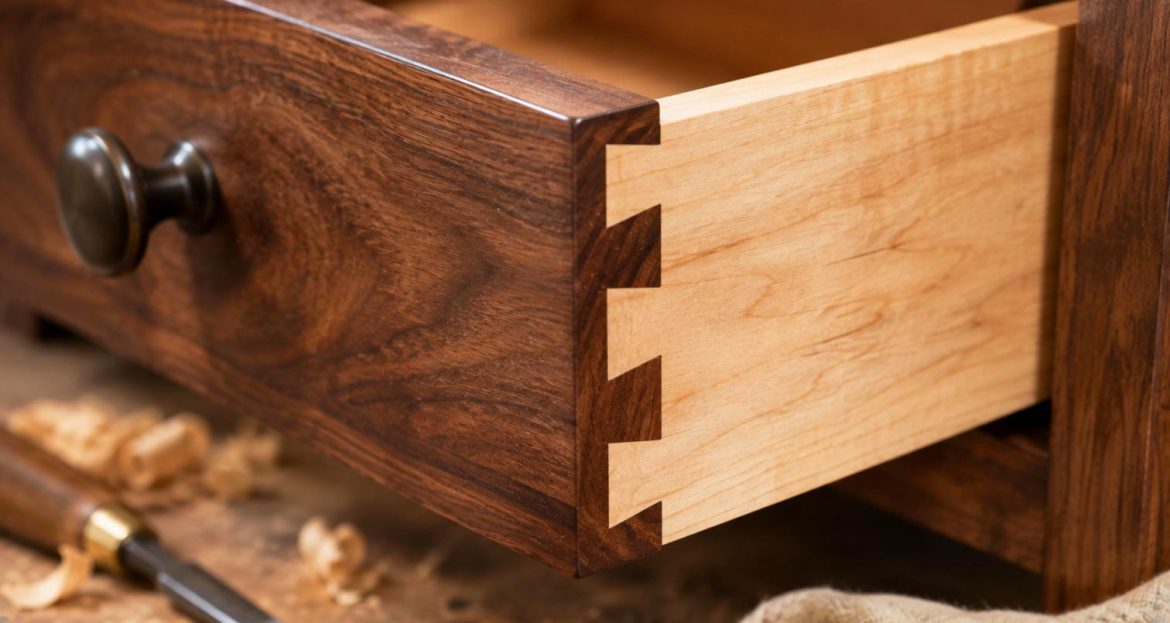
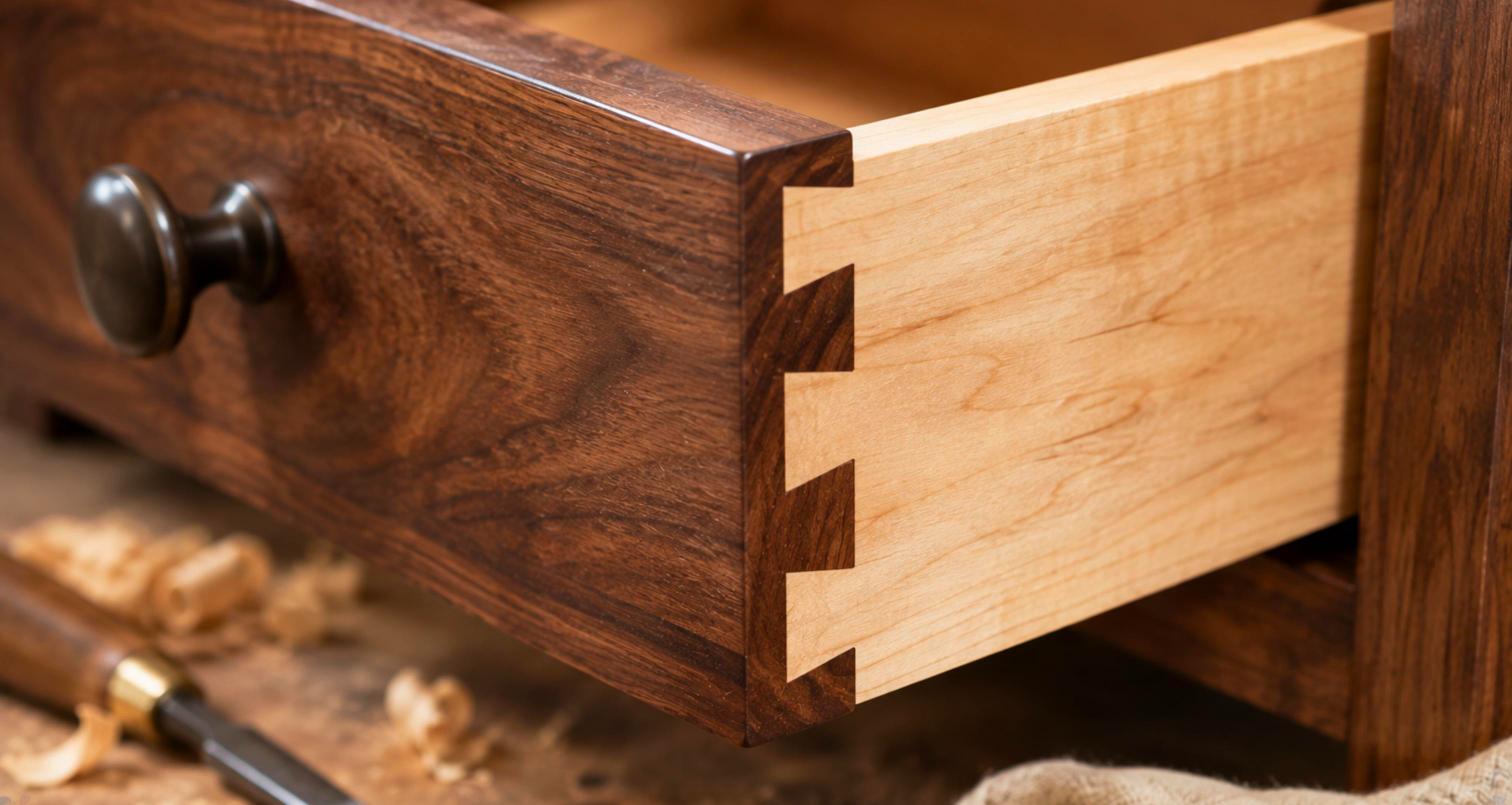
- Half-blind dovetail: visible only on the side, hidden from the front; the traditional choice for drawer fronts, as in the photo.
- Full-blind (secret) dovetail: completely hidden; used in fine cabinetry.
- Sliding dovetail: a dovetail-shaped groove and tongue that slide together; used to attach shelves or legs.
- French dovetail: a sliding dovetail common in drawer construction.
- English dovetail: drawer dovetails with narrow pins and wide tails, a sign of hand work.
Hand-cut vs. machine-cut
Hand-cut dovetails usually have very narrow pins and slight irregularities, and are found in antiques and high-end handmade furniture. Machine-cut dovetails, made with a router and jig, are perfectly uniform with evenly sized pins and tails. Both are strong; the hand-cut version shows more craftsmanship and often indicates a higher-value piece.
Using dovetails to judge furniture quality
- Open a drawer and look at the front corners.
- Dovetails indicate quality construction; stapled, nailed or simply glued corners are weaker.
- Check the drawer bottom: it should sit in grooves, not be stapled on.
- Look for solid-wood drawer sides rather than particleboard.
- Combine with smooth, full-extension glides for long-lasting drawers.
Dovetails vs. other joints
A mortise-and-tenon joint is the classic choice for frames, such as table legs and chair rails. Dowel joints, biscuits and pocket screws are faster to make and common in modern furniture. For drawers and boxes, dovetails are the benchmark for strength and longevity.
Related terms
Frequently asked questions
What is a dovetail joint?
An interlocking woodworking joint of flared tails and pins that resists being pulled apart.
Why are dovetail joints a sign of quality?
They are strong, long-lasting and take more skill or equipment to make than nailed or stapled joints.
How can you tell if dovetails are hand-cut?
Hand-cut dovetails often have very narrow pins and slight irregularities; machine-cut ones are perfectly uniform.
Where are dovetail joints used in furniture?
Mainly at drawer corners, and in boxes, chests and cabinet carcases.
Part of the Vancouver Furniture glossary of furniture, design and mattress terms. Browse furniture stores across Metro Vancouver or our mattress store guide.