Highboy: Definition, History, Highboy vs. Tallboy & Collecting Tips
The highboy is closely associated with 18th-century American furniture, particularly the Queen Anne and Chippendale styles made in cities such as Philadelphia, Boston and Newport. Cabinetmakers raised a chest of drawers on a legged base to make it easier to reach and to show off fine wood, carving and brass hardware. The term “highboy” itself is an American coinage; in Britain the closest equivalents are the “tallboy” and the “chest on stand”.
Highboys were status pieces, and the best antique examples are prized by collectors and museums. Reproductions and highboy-style chests remain popular in traditional and transitional bedrooms, where they provide a lot of storage on a small footprint.
Highboy vs. tallboy vs. chest-on-chest
- Highboy: upper chest on a lower base with legs, usually with a shaped apron.
- Tallboy / chest-on-chest: two full chests of drawers stacked, sitting on short bracket feet rather than tall legs.
- Lowboy: the lower section alone, used as a dressing table (see lowboy).
- Tall chest / chest of drawers: a single-case tall chest, common in modern furniture.
Defining features
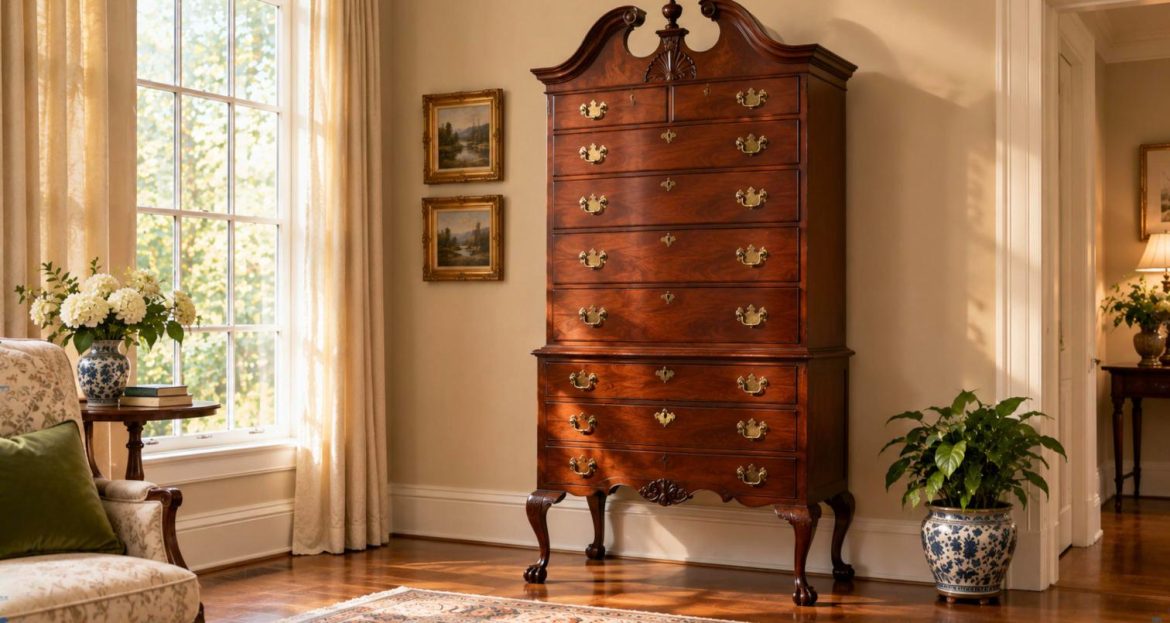
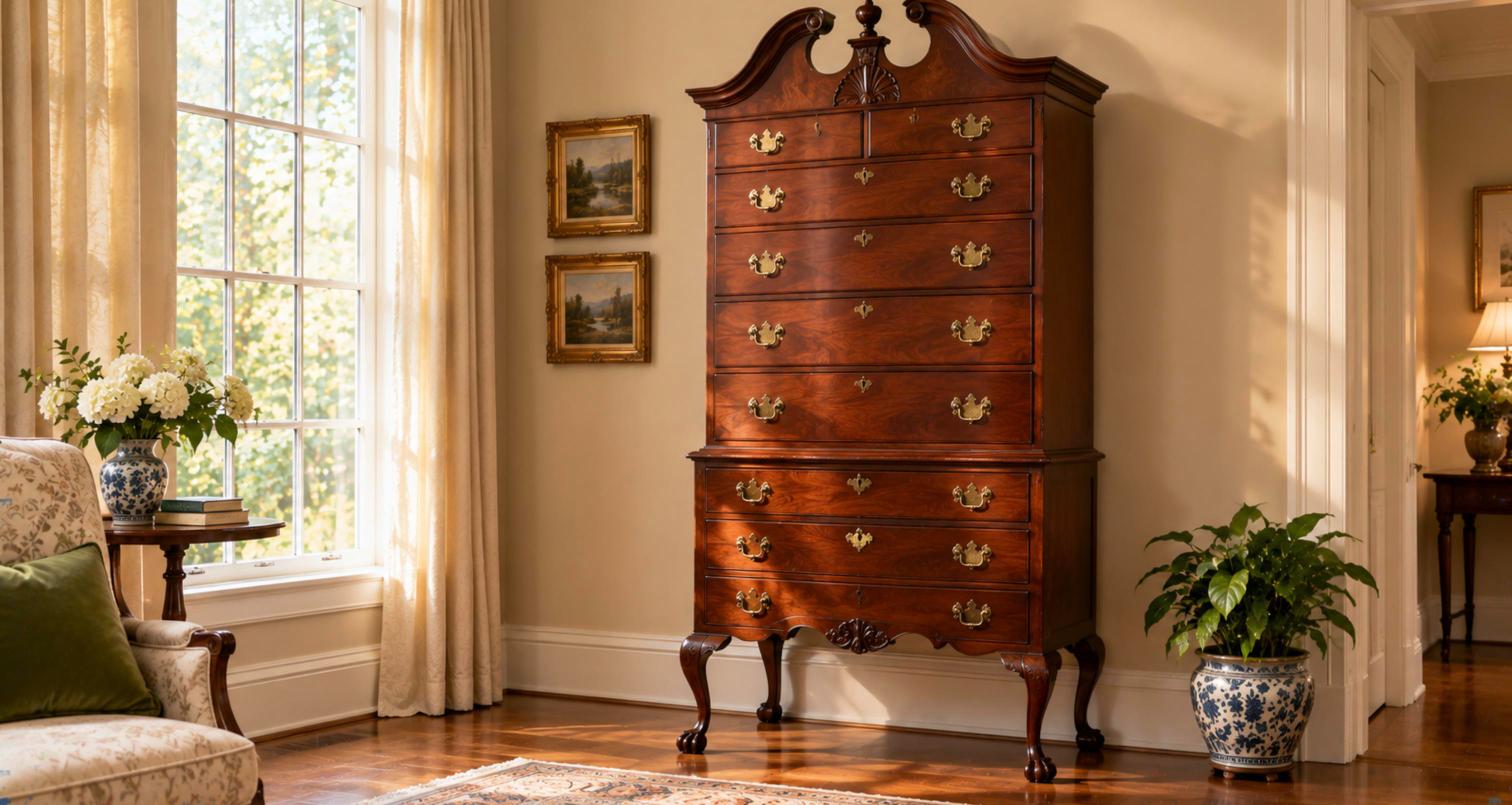
- Cabriole legs, often ending in pad, claw-and-ball or slipper feet.
- A shaped apron on the lower case, sometimes with carved shells.
- Bonnet or broken-pediment top with finials and carving, as in the photo.
- Graduated drawers, smaller at the top and larger below.
- Brass batwing or bail pulls and keyhole escutcheons.
Queen Anne vs. Chippendale highboys
Queen Anne highboys (roughly 1720s–1750s in America) are graceful, with simple curves, flat or bonnet tops and pad feet. Chippendale highboys (roughly 1750s–1790s) are more ornate, with claw-and-ball feet, elaborate carving and dramatic broken-pediment tops.
Using a highboy today
- Bedroom storage: a highboy holds as much as a wide dresser in a much smaller footprint.
- Dining room or hallway: as a statement piece for linens or china.
- Living room: drawers for games, media or files.
- Pair with modern furniture for contrast in transitional interiors.
Collecting and buying tips
- Check whether the upper and lower cases originally belonged together; “married” pieces are worth less.
- Look at drawer construction for hand-cut dovetails.
- Examine the legs and feet for repairs or replacements.
- Original hardware and finish add value.
- Get professional appraisal for high-value antiques.
Safety and moving
Highboys are top-heavy. Move them in two sections, and anchor the upper case to the wall, especially in earthquake-prone British Columbia. Keep heavier items in lower drawers.
Related terms
Frequently asked questions
What is a highboy?
A tall two-part chest of drawers with an upper chest on a legged lower base.
What is the difference between a highboy and a tallboy?
A highboy stands on tall legs; a tallboy is two chests stacked on short feet.
What is a lowboy?
The low, legged lower section of a highboy used alone as a dressing or side table.
Are antique highboys valuable?
Fine 18th-century American examples can be very valuable; condition and originality matter greatly.
Part of the Vancouver Furniture glossary of furniture, design and mattress terms. Browse furniture stores across Metro Vancouver or our mattress store guide.