Drop-Leaf Table: How It Works, Types, Sizes & Small-Space Tips
Drop-leaf tables have been used since at least the 16th century in Europe, when households needed furniture that could be set up for meals and then moved aside. They became especially popular in colonial North America, where homes were small and rooms served many purposes. The idea is simple and still brilliant: a table that is narrow and unobtrusive most of the time, but can seat more people in seconds.
That makes the drop-leaf table one of the most useful pieces for compact Vancouver condos, laneway homes and studios, where a full dining table would dominate the room. With both leaves down it can serve as a console or desk against a wall; with both raised it becomes a proper dining table.
How a drop-leaf table works
The leaves are attached to the central top with hinges, traditionally a “rule joint”, a curved interlocking edge that looks neat both when open and closed. To raise a leaf you lift it and swing out a support underneath. Supports vary:
- Swing arms or brackets: wooden or metal arms that pivot out from the apron.
- Pull-out slides: rails that slide out from under the top.
- Gate legs: an extra leg on a hinged frame swings out like a gate (see gateleg table).
- Butterfly brackets: small wing-shaped supports, common on smaller tables.
Types of drop-leaf tables
- Gateleg: swing-out legs support large leaves; very stable.
- Pembroke table: a small 18th-century English table with short leaves and a drawer, used as a side or breakfast table.
- Butterfly table: leaves supported by wing-shaped brackets.
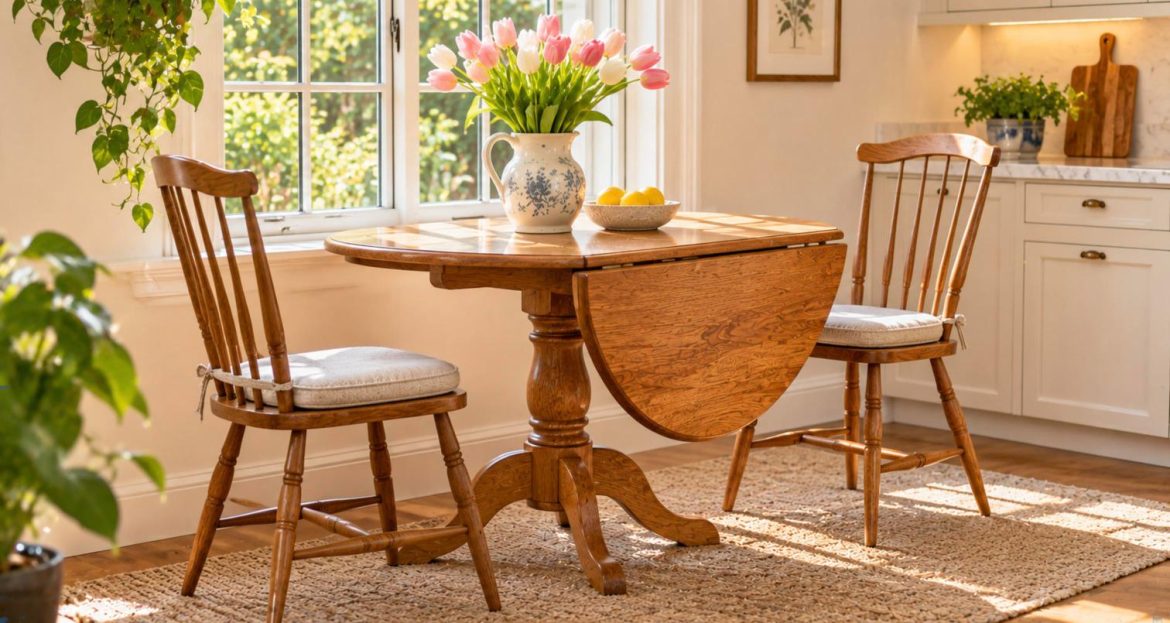
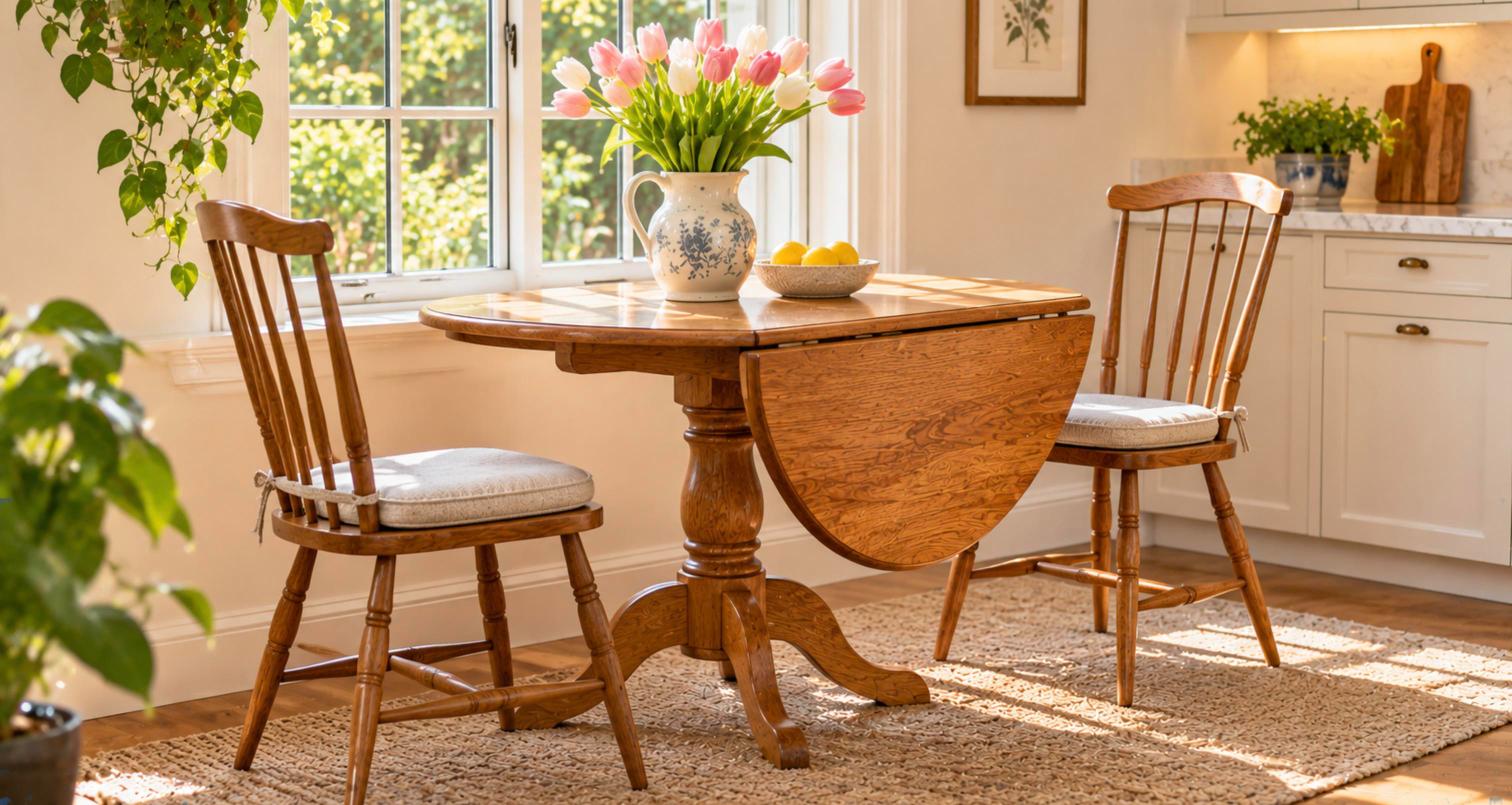
- Pedestal drop-leaf: a central pedestal base leaves more legroom, as in the photo.
- Wall-mounted drop-leaf: a single leaf folds against the wall, ideal for tiny kitchens and balconies.
Sizing guide
Measure the table both closed and open. A small drop-leaf might be 12 to 18 inches deep with leaves down and 36 to 42 inches with leaves up, seating two to four. Larger gateleg tables can open to 60 inches or more and seat six. Leave around 36 inches of clearance around the open table for chairs, the same as any dining table.
Pros and cons
Pros: saves space, flexible, can double as a console or desk, often affordable, and widely available vintage. Cons: supports and legs can get in the way of knees, hinges need occasional tightening, and leaves can sag if supports are weak.
Using one in a small space
- Keep it against a wall with one leaf down for daily meals for two.
- Pull it out and raise both leaves when guests come.
- Pair with folding or stacking chairs stored nearby, or a bench that tucks under.
- Use it as a desk during the day and a dining table at night.
Buying tips
- Open and close the leaves several times to test the hinges and supports.
- Check that open leaves sit level with the centre top.
- Look for a rule joint or tight seam between top and leaves.
- Choose solid wood or quality veneer; thin particleboard leaves can warp.
- Consider legroom: pedestal bases are easiest for seating.
Caring for a drop-leaf table
Tighten hinge screws occasionally, wax wooden slides so they move smoothly, and avoid leaning on an open leaf, which can strain the supports. Wipe spills promptly, especially along the hinge line.
Related terms
Frequently asked questions
What is a drop-leaf table?
A table with hinged leaves that hang down when not needed and lift up to extend the top.
What is the difference between a drop-leaf and a gateleg table?
A gateleg table is a type of drop-leaf table whose leaves are supported by swing-out legs.
Are drop-leaf tables sturdy?
Good ones are, especially gateleg and pedestal designs with solid supports.
Are drop-leaf tables good for small apartments?
Yes. They stay compact most of the time and expand when you need more seating.
Part of the Vancouver Furniture glossary of furniture, design and mattress terms. Browse furniture stores across Metro Vancouver or our mattress store guide.