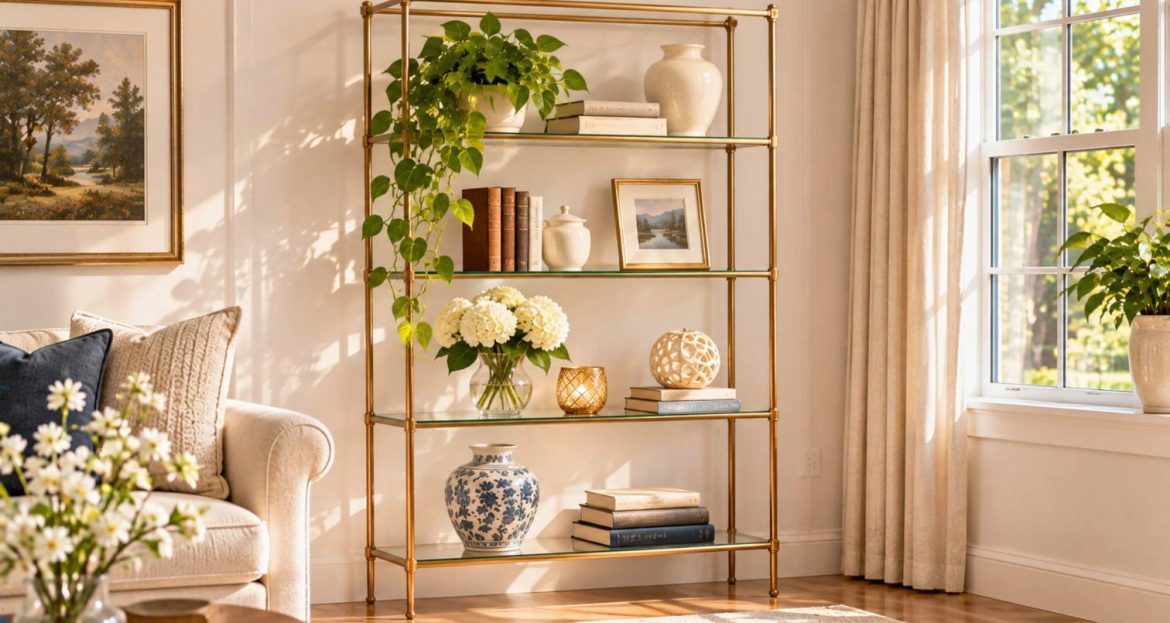
Étagère: Meaning, History, Étagère vs. Bookcase & Styling Ideas
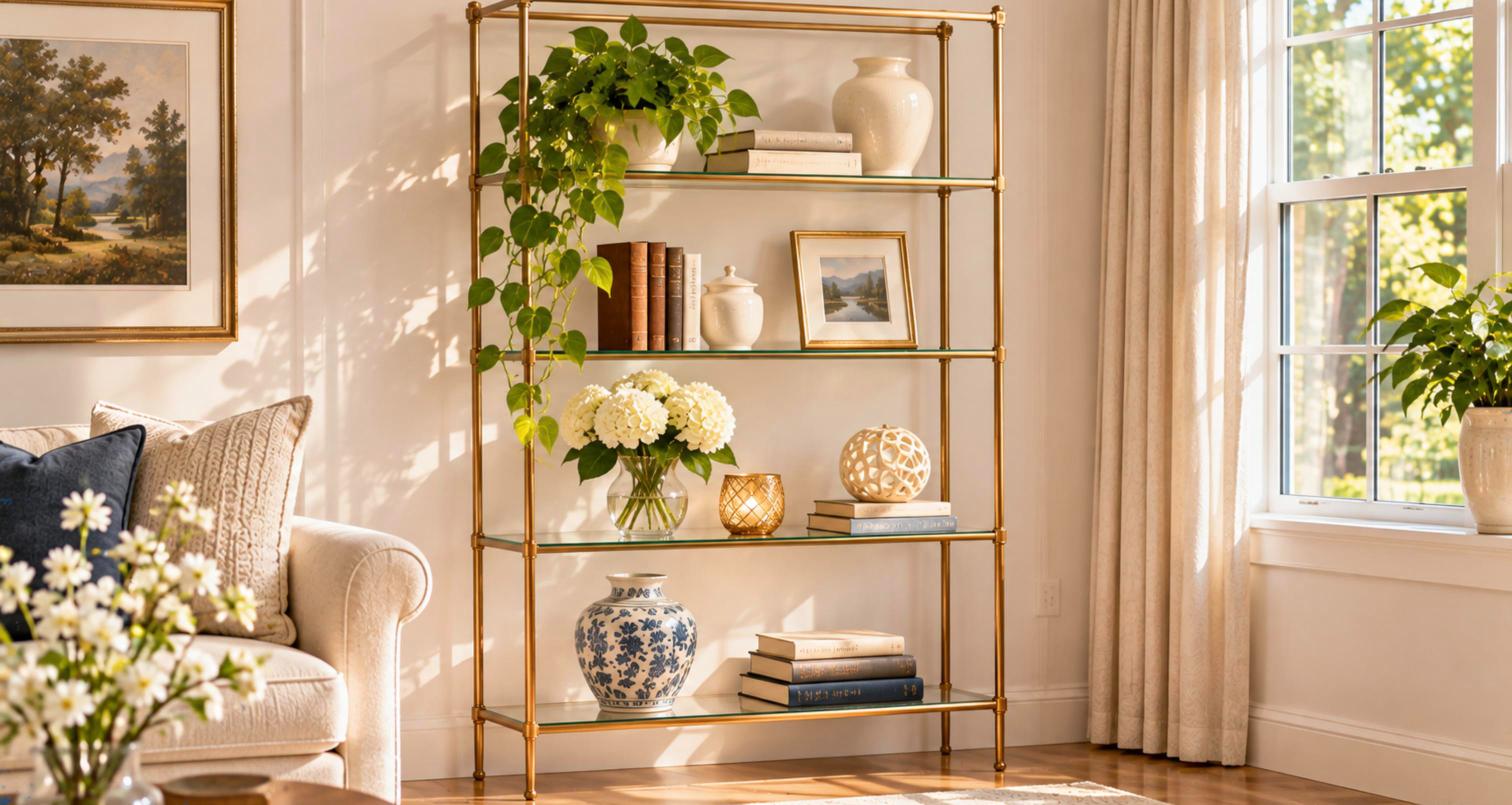
Étagères appeared in 18th-century France as elegant whatnots for showing off porcelain, curiosities and small treasures, and they became fashionable throughout Europe and North America in the Victorian era. Their defining quality is openness: a light frame of wood or metal with shelves that let light and views pass through, so the objects, not the furniture, take centre stage.
Modern étagères range from slim brass-and-glass designs, like the one in the photo, to industrial pipe-and-wood shelving and Scandinavian ladder shelves. Because they are visually light, they are a smart way to add display space in small rooms without the bulk of a closed cabinet.
Étagère vs. bookcase vs. curio cabinet
- Étagère: open shelves, minimal frame, mostly decorative display.
- Bookcase: usually has solid sides and a back panel, built for the weight of books.
- Curio cabinet: glass-enclosed, protecting collectibles from dust.
- Baker’s rack: a metal open rack originally for kitchens.
Types of étagères
- Metal and glass: brass, gold or chrome frames with glass shelves; glamorous and light.
- Wood: solid or veneered shelves on a slim wooden frame; warm and versatile.
- Industrial: black metal with reclaimed wood shelves.
- Ladder or leaning: leans against the wall with narrowing shelves.
- Corner étagère: triangular shelves for corners.
- Tiered side-table étagère: small two- or three-tier stands beside a sofa or bed.
How to style an étagère
- Start with a few larger anchor objects, such as vases or stacked books, spread across the shelves.
- Add medium items like framed photos, ceramics and plants.
- Finish with small accents, but leave plenty of empty space.
- Use the rule of three: group objects in odd numbers.
- Repeat colours or materials from shelf to shelf for cohesion.
- Trailing plants, as in the photo, soften metal frames.
Practical considerations
Check weight limits, especially on glass shelves; étagères are usually not designed for heavy book collections. Anchor tall units to the wall, a must in earthquake-prone BC. Use tempered glass, and add small rubber bumpers under objects on glass to prevent sliding.
Where to use an étagère
- Living rooms, beside a fireplace or sofa.
- Dining rooms, to display serving pieces.
- Bathrooms, for towels and toiletries (choose moisture-resistant materials).
- Entryways, for keys and baskets on lower shelves.
- Home offices, combining books and décor.
- As a semi-transparent room divider in open-plan condos.
Buying tips
Look for a stable base, level shelves and solid joints. Brass and gold finishes suit glam, Art Deco and transitional rooms; black metal suits industrial and modern spaces; wood suits Scandinavian and traditional rooms. Measure height carefully if placing under a window or slanted ceiling.
Related terms
Frequently asked questions
What is an étagère?
A freestanding open shelving unit, usually without doors or back panels, used to display objects.
How do you pronounce étagère?
Roughly “ay-tah-ZHAIR”.
What is the difference between an étagère and a bookcase?
An étagère is open and mainly decorative; a bookcase usually has solid sides and a back and is built for books.
Should an étagère be anchored to the wall?
Yes, tall units should be anchored, especially in earthquake zones.
Part of the Vancouver Furniture glossary of furniture, design and mattress terms. Browse furniture stores across Metro Vancouver or our mattress store guide.