Particleboard Furniture: What It Is, Pros, Cons & How Long It Lasts
Particleboard was developed in the mid-20th century as a way to turn sawmill waste into a useful, low-cost panel. It made mass-produced, ready-to-assemble furniture possible and is today used in a large share of bookcases, desks, wardrobes, kitchen cabinet boxes and dressers.
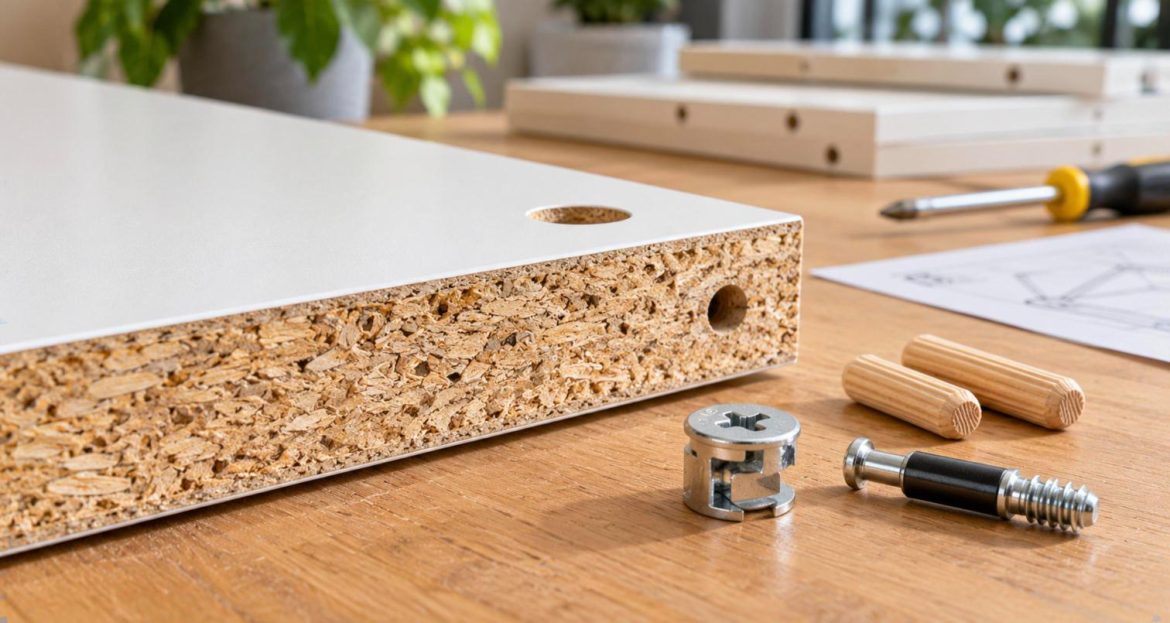
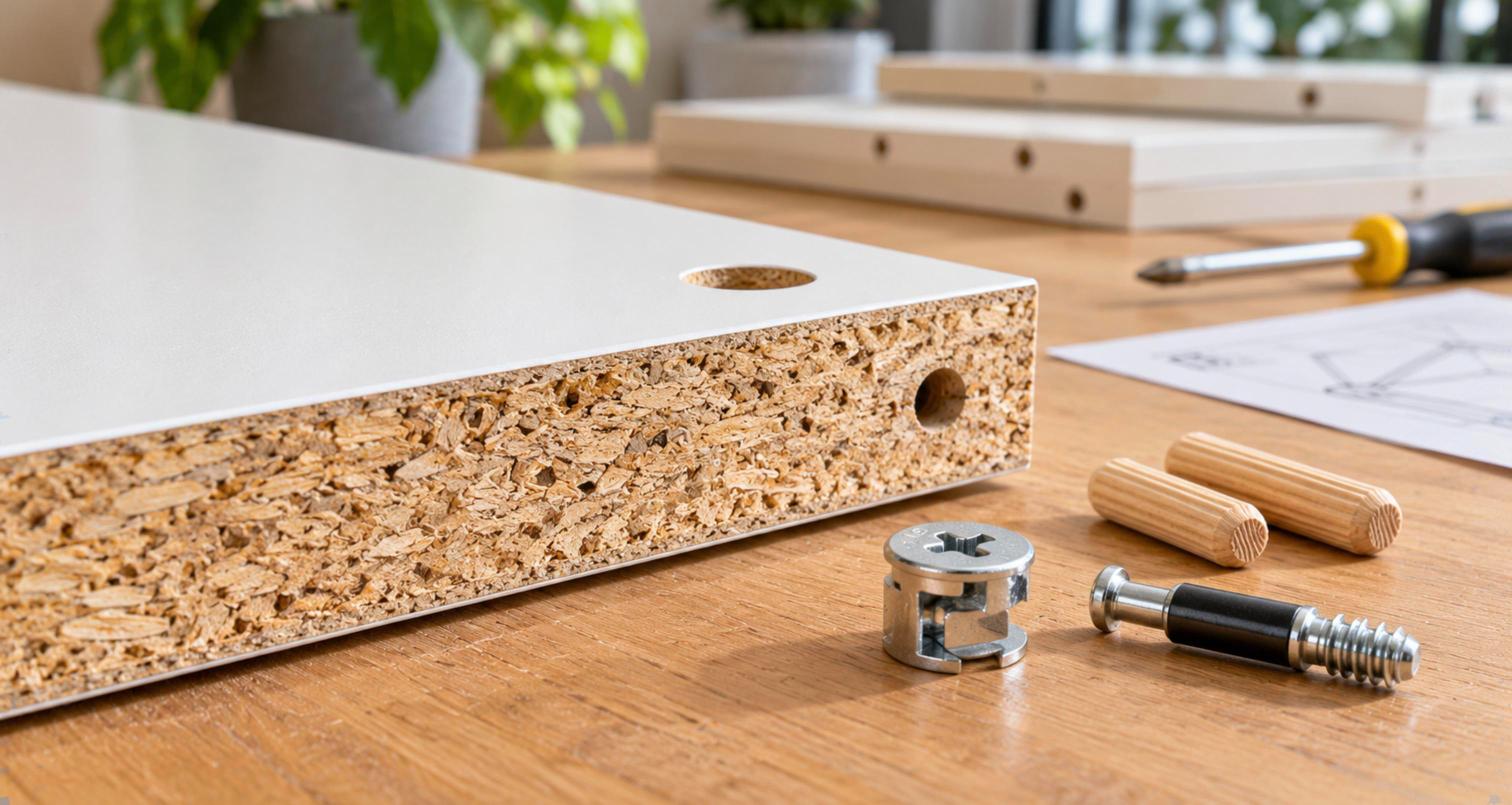
The photo shows a typical particleboard panel cut open: a core of compressed wood particles, a white melamine surface, a pre-drilled hole for a cam lock, and the cam-lock fitting and wooden dowels that hold flat-pack furniture together. Understanding this construction helps set realistic expectations about durability.
How it is made
Wood particles are dried, sorted by size and mixed with adhesive resins, traditionally urea-formaldehyde. The mixture is formed into mats, often with finer particles on the surfaces and coarser ones in the core, then pressed under heat. The panels are sanded and finished with decorative surfaces.
Common surface finishes
- Melamine: resin-impregnated paper fused to the surface; durable, easy to clean and available in solid colours or wood patterns.
- High-pressure laminate: thicker and more durable, often used on countertops and desks.
- Thermofoil: a vinyl film heat-formed over the surface.
- Wood veneer: a thin layer of real wood for a natural look.
Pros
- Low cost, making furniture affordable.
- Uses wood waste, reducing raw lumber needs.
- Flat and dimensionally uniform, so it does not warp like solid wood under normal conditions.
- Lightweight compared with MDF.
- Easy to machine for flat-pack hardware.
Cons
- Swells, crumbles and loses strength when exposed to water.
- Holds screws poorly, and holes strip easily.
- Does not tolerate repeated disassembly and moving.
- Shelves can sag under heavy loads.
- Cannot be sanded or refinished.
- Some resins emit formaldehyde; look for low-emission certifications.
Particleboard vs. MDF vs. plywood
- MDF: denser and smoother, better for paint and routed edges, heavier.
- Plywood: much stronger, holds screws better, more moisture-tolerant and more expensive.
- Particleboard: the cheapest and weakest, fine for light-duty use when kept dry.
How to make particleboard furniture last
- Keep it dry; seal exposed edges and wipe spills immediately.
- Do not overtighten screws or cam locks.
- Use wood glue in dowel joints during assembly for extra strength.
- Avoid overloading shelves; add a centre support for long spans.
- When moving, disassemble carefully and use new fittings if holes are worn.
- Anchor tall pieces to the wall.
How to tell if furniture is particleboard
Look at unfinished edges, the back panel, the underside or inside of drill holes: particleboard shows a coarse, chunky texture. It is also lighter than solid wood. Product descriptions may say “engineered wood”, “composite wood” or “wood-based panels”.
Related terms
Frequently asked questions
Is particleboard furniture good?
It is fine for light-duty use and tight budgets, but less durable than plywood or solid wood.
What is the difference between particleboard and MDF?
MDF is made from fine fibres and is denser and smoother; particleboard uses larger chips and is weaker.
Can particleboard get wet?
It swells and weakens when wet, so seal edges and keep it dry.
How long does particleboard furniture last?
With care and light use it can last years, but it rarely survives repeated moves.
Part of the Vancouver Furniture glossary of furniture, design and mattress terms. Browse furniture stores across Metro Vancouver or our mattress store guide.